Seller NotesPrices updated November 2026
How to Sell Websites to Local Businesses, Demo First
- Build the owner's site before you ask for a dollar, then open it on their own phone.
- Start with roofers and mechanics. In our directories, 54.6% of roofers and 48.3% of auto shops have no real website, against 19.3% of locksmiths.
- Bring one local fact the owner can't ignore, like the rival down the street with 188 reviews to their 19.
- Charge a setup price they can say yes to that day, plus a monthly fee, so the sale doesn't end at launch.
- Call or walk in. Don't cold text. Email is legal, but the rules apply to business email too.
- Put domain, copyright and what happens when they stop paying in writing. Copyright doesn't move without a signature.
Author Source EEAT Authors · Anthony's Author Page
You sell a website to a local business by showing the owner their own finished site before you ask for money. That works because an owner can't picture a pitch, but they can look at their own name, their own truck and their own phone number on a screen in their hand.
I've seen this from both sides. The way we pitch now came out of pitching shops by hand, one owner at a time. Our all-time count, from Clickflame company records, is 2,677 audits run, 1,398 sites made and 438 clients. That's about one client for every three sites. It isn't a promise about your close rate, but it shows why I'd never go back to pitching with words alone.
Pick Owners Who Are Easy to Reach
Start with people who know your face. A mechanic you use, the roofer who did your mom's house, the locksmith from your church. A stranger may ignore a demo, while someone who knows you will at least open it.
When you run out of those, go by trade instead of by guesswork. We counted 62,262 trade listings in our own directories in October 2026. A listing counts as having no real website when it shows no site at all, or only a social or directory page.
| Trade | Listings | No Real Website |
|---|---|---|
| Roofers | 3,040 | 54.6% |
| Auto repair and mobile mechanics | 45,668 | 48.3% |
| Electricians | 3,799 | 44.7% |
| Locksmiths | 9,755 | 19.3% |
| All four trades | 62,262 | 43.9% |
Your city changes the odds too. In the same count, 45.6% of 804 listings in Los Angeles had no real website, while San Diego sat at 29.2% of 281. Those cities are two hours apart, so check yours in the counts by trade and city before you plan a week around one trade.
Then split your list in two. Owners with no site need the idea sold first. Owners with a bad site already believe in websites, so they need proof that theirs is costing them. I find the second group is the easier talk, because you aren't asking them to change their mind about anything.
Build the Demo Before the First Talk
A demo isn't a mockup with stock photos and a fake address. It's a working site with the owner's real name, phone, services, city and colors, taken from what they've already put online. If they have photos of their own work, use those.
- Build it for a phone first, since that's where the owner will see it and where their customers will too.
- Make the phone number tap to call and test it.
- Only list services they actually offer. One wrong service tells them you didn't look.
- Keep it out of Google search results, and take it down the day they ask. They never asked for this site to exist.
- Don't show it in your portfolio until they buy.
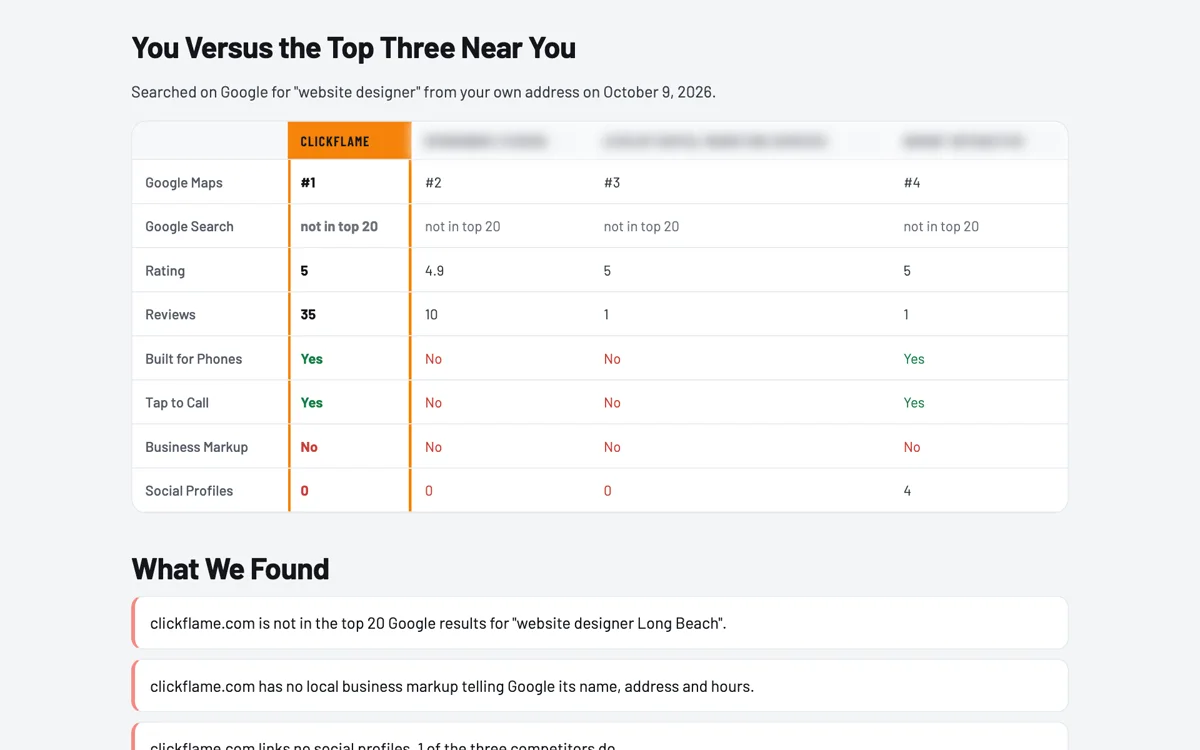
Next, add one page of local facts. We looked at 35 of our own audits run from September 28 to October 11, 2026, and the patterns repeat. The top rival near each business had a median of 188 Google reviews, and the business had 19. Twelve of the 35 didn't reach the top 20 on the map for their own main service, searched from their own address.
The site problems were just as plain. Of 28 sites checked, 20 had no local business markup, which is the code Google reads for name, address and hours. Median load time for the main content on a phone was 5.6 seconds, and Google's bar for good is 2.5 seconds. Say those things in plain words, because an owner won't care about markup but will care that the shop across town shows up and theirs doesn't.
Call or Walk In, Then Hand Them the Phone
Go at a slow hour. For most trades that means early morning or late in the day, not when a customer is standing at the counter. Keep your opener under 15 seconds and ask for permission before you send anything.
Hi, is this [owner]? This is [your name], I'm over in [your town]. I built a website for [business] and I'd like you to see it. There's no charge to look. Can I text you the link, or should I bring it by?
Then stop talking. When they open it, let them scroll. Most of what you'd say, they'll say first, and what they point at tells you what they care about. If they want it, ask for the sale right there, with a price they can approve that day.
The rules differ by channel, and most sales advice skips them.
- Calls. The FTC says most calls to a business are exempt from its Telemarketing Sales Rule, apart from sales of office and cleaning supplies. A live call from you, by hand, is the cleanest start. Still, keep your own list of anyone who asks you not to call again.
- Email. CAN-SPAM has no business exception. You need a true From line, a real postal address and an opt out you honor within 10 business days. The FTC guide lists penalties of up to $53,088 per email.
- Texts. This is where sellers get hurt, because a small owner's business line is often a cell phone. FCC rules require signed written consent for autodialed marketing to a cell number, and that paragraph has no carve out for business owners. Federal do not call rules can reach cell numbers as well.
So I don't cold text owners at all. I send one link, by hand, after they say yes on the phone or in person. Check your own state's rules too, since some go further than the federal ones.
Price It So You Still Have a Client Next Year
A one time sale pays you once and leaves the owner with a site no one is watching. A small setup price with a monthly fee is easier for them to say yes to, and it keeps you in the conversation. Most of our own price list is built that way. A site is $150 with the first year of hosting free, then $25 a month.
What One Client Pays Over Time
The bigger number sits after the website. Our marketing plan is $800 a month, month to month, which comes to $9,600 in a year from one owner who stays. The owner stays only if the phone rings, so don't sell it unless someone can do the work. The site is what opens the door, and that's a good reason to keep its price low.
You'll see guides quote a range of a few hundred to a few thousand dollars with no source behind it. Your price depends on your costs and your town, so I'd only trust prices someone actually sells at. Call three local designers if you want to know your market.
Put Ownership in Writing Before You Launch
Almost nobody selling websites talks about this, and it's what turns a happy client into a fight two years later. Copyright starts with the author of the work, and a transfer isn't valid without a signed writing. So paying for a site doesn't by itself hand the owner the copyright.
Don't lean on the words "work made for hire" to fix that. Circular 30 says commissioned work only qualifies if it fits one of nine listed categories and both sides sign an agreement that says so. A website isn't named on that list. Use a plain signed transfer, or a signed license, and have a lawyer read your template once.
Your one page agreement should answer these.
- Whose name is on the domain. I'd put it in the owner's name. ICANN says the registrant carries sole responsibility for the registration and its use, so that person should be the one who runs the business.
- Who holds the copyright to the design, the words and the photos, and when it moves.
- What the monthly fee covers, and what counts as extra.
- What happens to the site and files when they stop paying.
- That no one is promising a Google ranking or a number of calls.
Common Misreads
People say you should sell business results and never talk about the website. I'd say the opposite on a first call. Owners have heard results promised by a dozen callers, and the site is the only thing in the room they can check for themselves.
People also treat every business with no website as a lead. It isn't. A list tells you who lacks a site, not who wants one, and a busy roofer with six months of work can say no and be right. That's why I'd rather talk to 20 owners I can reach than blast 2,000 names from a scraped list.
Last, new tools make building feel like the hard part is over. Building did get cheaper, so owners are hearing more of these pitches. In my view that makes the local facts and the follow through worth more, since anyone can make a pretty page and few will tell an owner exactly who is beating them and then stick around to fix it.
What Comes Up on Calls
- I already have a Facebook page. Why would I need a website?
- Don't argue with it. In our count, 2,744 trade listings had only a social or directory page, so you'll hear this a lot. Open the demo beside the Facebook page on their phone and ask which one they'd want a new customer to see first. Then point out that the site, the domain and the customer form stay theirs.
- I get all my work from word of mouth. What would this do for me?
- Agree with them, because it's probably true. Then say that people who get their name from a friend still look them up before they call. Show what that person finds today, and show the demo. If they're booked solid and happy, thank them and move on.
- Will this put me first on Google?
- No one can promise that, and I'd walk away from anyone who does. Show where they rank now from their own address, name the rivals above them and list the work you'd do. Then let the numbers move or not move in front of them.
- Who owns the site if I stop paying?
- Have the answer in your contract before they ask. Mine would cover four things, which are the domain, the copyright, the hosting and how they get their files. An owner who hears a clear answer to this one tends to trust the rest of what you say.
- How much should I charge a local business for a website?
- Pick a price the owner can approve on the spot without a second opinion, then add a monthly fee for hosting or marketing. We sell a site at $150 with a free first year of hosting, then $25 a month. Our marketing plan is $800 a month, month to month.
- Do I need to know how to code to sell websites?
- No. You need someone who can build it, fix it at 7pm and answer the owner's questions next year. If that person isn't you, line them up before you sell, and tell the owner who does the work.
Keep w3bsiter in your Google results
Public Records Used
FTC, CAN-SPAM Act Compliance Guide for Business
FTC, Complying with the Telemarketing Sales Rule
47 CFR 64.1200, FCC telemarketing rules, Cornell Legal Information Institute
U.S. Copyright Office, Circular 30, Works Made for Hire
U.S. Copyright Office, Title 17, Chapter 2, Copyright Ownership and Transfer
ICANN, Registrants' Benefits and Responsibilities
web.dev, Largest Contentful Paint
Google Search Central, Local Business Structured Data
You Might Need This Too
w3bsiter is the sales program for people who would rather find and close owners than build sites. We do the marketing and you keep 50% of what the client pays. See how the split works.