Seller NotesRates updated November 2026
How Much to Charge for a Website, From the $47.85 Hour Up
- Start from an hour, not a range you read somewhere. The federal median for web developers and digital designers is $47.85 an hour.
- Working for yourself, you pay the full 15.3% Social Security and Medicare tax, and part of every week goes unbilled. In my worked example that lifts the floor to about $70 an hour.
- Count the hours a five page local site really takes. My worked example lands at 21 hours, or about $1,480.
- Check the price against the owner's own work. A mechanic who bills $150 an hour hears $1,480 as about ten hours on a car.
- Put the deposit, the number of change rounds and the price of extras in writing, and keep the domain in the owner's name.

Author Source EEAT Authors · Anthony's Author Page
Charge at least about $70 for every hour a website really takes you, and build the quote from those hours. For a five page local service site that comes to roughly $1,500 in my worked example below. The floor starts at the $47.85 median wage for web developers and designers, then climbs once you pay your own taxes and count the hours nobody pays for.
Most pricing advice gives you a range, like a few hundred dollars for a simple site and several thousand for a custom one. A range doesn't tell you what to say when an owner asks for a number on the phone. A floor you built yourself does, and you can explain every line of it.
So I'll build one from public numbers. Then I'll put it next to the owner's own work, because that's the scale they use to judge it.
Start With the Hour You Have to Clear
The Bureau of Labor Statistics puts the median pay for web developers and digital designers at $99,520 a year, or $47.85 an hour. Half of the people in that job earn more and half earn less. It's a fair starting point because it's what an employer would pay for the same skill.
That wage comes with things a freelancer doesn't get. The first is taxes. The IRS sets self-employment tax at 15.3%, which is 12.4% for Social Security and 2.9% for Medicare. On a paycheck, the employer pays half of that. When you work for yourself, you pay all of it, and you get to deduct the employer half from your income, per IRS Topic 554. To match a $47.85 paycheck, you need about 7.65% more, which is $51.51.
The second is unbilled time. Nobody pays you for sales calls, invoices, quotes that go nowhere or learning a new tool. In my worked example, 30 of every 40 hours get billed. Divide $51.51 by 0.75 and the hour climbs to $68.68.
The third is tools. Say your software, stock assets and test hosting run $200 a month. Spread across 120 billed hours, that's about $1.67 an hour. Now you're at $70.35.
How the Hourly Floor Builds Up
That $70 is a floor, not a target. It still leaves out health insurance, paid time off and saving for a slow month. If you pay for those yourself, your floor is higher. Treat it as the lowest hour you can sell without losing money.
Count the Hours a Local Site Really Takes
Owners don't buy hours. They buy a site. But your quote should still come from hours, because that's the only way to know it covers your floor. Take a five page site for a local service business, the kind with a home page, a services page, an area page, an about page and a contact page.
| Task | Hours | At $70.35 |
|---|---|---|
| Kickoff call, then collecting photos, hours, services and towns served | 2 | $140.70 |
| Writing the words for five pages | 5 | $351.75 |
| Design and build | 8 | $562.80 |
| Matching the name, address, phone and hours to the Google profile | 1 | $70.35 |
| Launch checks and testing on a phone | 2 | $140.70 |
| Two rounds of changes | 3 | $211.05 |
| Total | 21 | $1,477.35 |
These hours are a worked example, not a measurement. Time your next two builds and replace them with your own. The task list matters more than my numbers. Writing the words is where quotes go wrong most often. Owners rarely send copy, so if your quote assumes they will, you end up writing it for free.
The launch line isn't padding either. A site that ships with a search block still switched on, or a form that goes nowhere, costs you more hours later than it saves now. Our launch checklist for client sites is the list I'd time against.
Round the total to a number you can say out loud. In this example that's $1,480 or $1,500. If you work from a template you already know, the design and build line might drop to three hours. The quote drops to about $1,130. Your hour stays the same.
Then Check the Price Against the Owner's Jobs
A business owner doesn't compare your price to other designers first. They compare it to their own work. So turn your quote into their units before you say it.
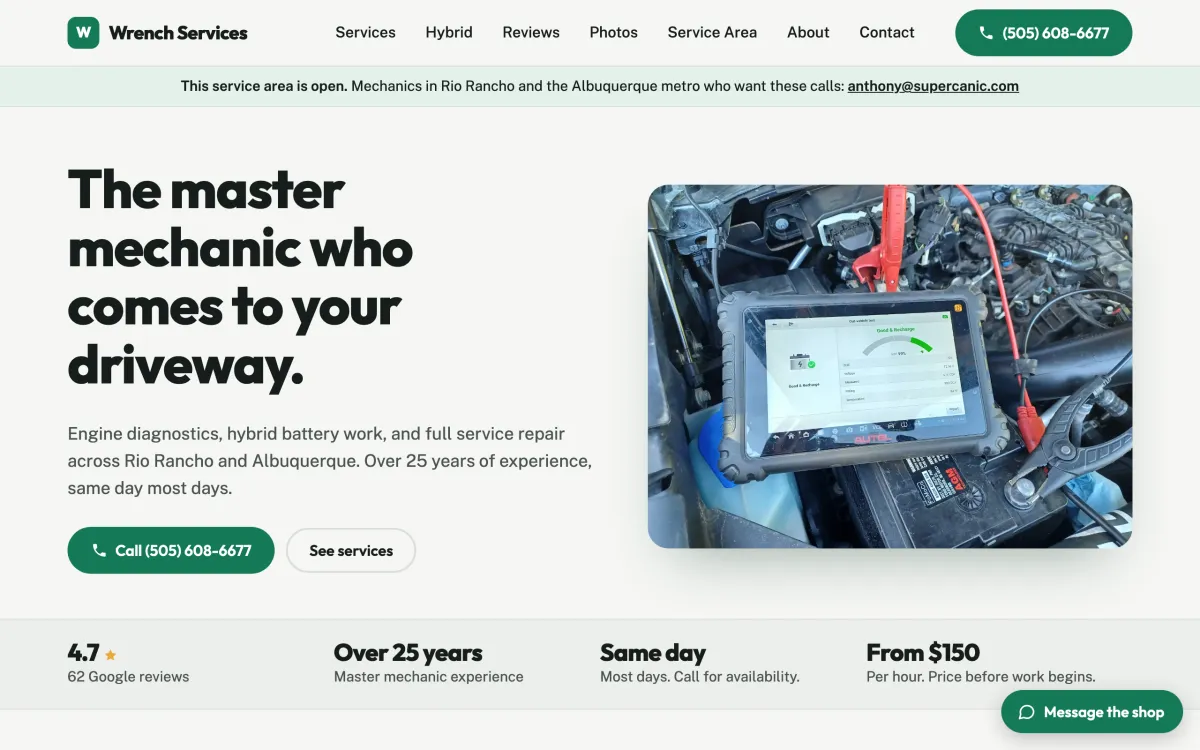
A mobile mechanic who bills $150 an hour hears $1,480 as about ten hours of labor. That's one big job or a few small ones. Say it that way. "This costs you about ten hours on a car, once." It's a number they can picture, and it makes the next question easy. How many new jobs a year would pay that back?
Plenty of owners have never answered that question, because they've never had a site. In our Local Visibility Index, 38.5% of 25,538 business listings for mechanics, roofers, electricians and locksmiths had no real website, as of October 11, 2026. Among roofers it was 54.6%. Those owners aren't comparing you to their last designer. They're comparing you to doing nothing.
Some of them used to have a free site. Google shut down the websites it made from Business Profiles on March 1, 2024, and sent visitors to the profile only until June 10, 2024. If an owner says "Google gave me a website," check. It may be gone.
Pick One Way to Bill and Say It Plainly
Once you know the hours, you still have to pick how the owner pays. There are three common ways, and each puts the risk on a different person.
| Way to Bill | Who Carries the Risk | Fits When |
|---|---|---|
| Flat fee for the build | You. If it runs long, you eat the hours. | The scope is clear and you've built this kind of site before. |
| Hourly | The owner. They can't know the total up front. | The job is a repair or an add-on with no clear end. |
| Small build fee plus a monthly plan | Shared. The monthly pays back the build over time. | You'll keep the site updated and watched after launch. |
Most local owners want a flat number. An open hourly quote feels like a blank check to someone who has never bought a website. I'd quote flat, built from your hours, and keep hourly for small fixes after launch.
The monthly model changes the build price on purpose. Our own price list sells a website at $150 and a marketing plan at $800 a month, per our pricing page. The build is cheap because the work and the money come after it. That only works if someone really does the monthly work. If you sell a monthly plan, price it from its own hours. Our website maintenance cost breakdown puts a small WordPress site at about $62 a month before profit.
The site is five pages, written for you, with two rounds of changes. It's $1,480. Half starts the work, and the rest is due when you approve the site to go live. The domain goes in your name.
That's a quote an owner can approve on the call. It names the scope, the price, the payment and who owns what. Nothing in it needs a follow up email to explain.
Put the Deposit, Changes and Extras on Paper
Most pricing fights aren't about the price. They're about what the price included. Write these four things down before you start, and have the owner say yes to them.
- The deposit. I'd ask for half before any work begins. It covers your time if the owner disappears, and it tells you they're serious.
- The number of change rounds. Two is plenty for a five page site. Say what a third round costs, in hours at your rate, so it's not a surprise.
- The price of extras. An added page, a second language, a booking tool or a photo shoot each get their own price. Write a short list so the owner can see it.
- Who holds the domain. Register it in the owner's name. ICANN says the person who holds a domain must keep the registration details accurate and up to date, so the renewal notices should reach the owner, not you.
That last point protects you as much as the owner. Data for Trades crawled 22,084 auto repair shop websites and found that 845 shops still list a website whose domain no longer resolves. Some of those were a builder who moved on and a renewal nobody saw. You don't want your name on that story.
Common Misreads
"Charge what the market pays." Ranges you find online rarely say who paid them or for what. Your floor comes from your own hour and your own hours on the job. If the market in your town pays less than that, you need a faster build, not a lower hour.
"A template site should be cheap." A template cuts the build hours, so the quote should drop. Your hourly rate shouldn't. The words, the photos, the Google match and the launch checks still take the same time.
"The lowest price wins the owner." Owners decide on whether the site will bring them work. A low price with nobody watching the site after launch leaves them with a page that slowly breaks. Price the build so you can still answer their call next year.
"Hourly is fairer to the owner." It's fairer to you. The owner can't approve a number they don't know. A flat quote built from your hours gives them a yes or no, and gives you a clear line when they ask for more.
What Comes Up on Calls
- How much should I charge for a 5 page website?
- Count your hours first. In the worked example on this page, a five page site for a local service business takes 21 hours, and at about $70 an hour that's roughly $1,480. If you start from a template you already know well, the hours drop, and so should the quote. Your hourly floor stays the same either way.
- Should a beginner charge less?
- A beginner is slower, so the same site takes more hours. Don't cut the hourly floor to make up for it, or you'll work at a loss. Quote what the site is worth in hours a practiced builder would need, and eat your own learning time as the cost of getting faster.
- Do I charge the owner for the domain and hosting?
- Yes, but as their own lines and at what they really cost, with the domain registered in the owner's name. Our maintenance cost breakdown has the list prices. Mixing those bills into the build price hides them, and the owner finds out when something renews.
- What do I say when an owner says another designer quoted $500?
- Ask what the $500 includes. How many pages, who writes the words, how many rounds of changes, and who holds the domain. Then show your hours line by line. Some owners still take the $500, and that's fine. You can't build a five page site in seven hours without cutting something.
- Can't the owner just get a free website from Google?
- Not anymore. Google stopped the free websites it made from Business Profiles on March 1, 2024, and sent visitors to the profile for a few months after that. Owners who had one now have a profile with no site, and that's a fair place to start the conversation.
- How do I raise my price for clients I already have?
- Give them notice in writing, a month or more, and tie the raise to something real like a new task in the plan or a higher bill. Keep the old price on work already agreed. Most owners take a raise better when they hear it from you before the invoice shows it.
Keep w3bsiter in your Google results
Public Records Used
U.S. Bureau of Labor Statistics, Web Developers and Digital Designers
IRS, Self-Employment Tax (Social Security and Medicare Taxes)
IRS, Topic No. 554, Self-Employment Tax
Search Engine Roundtable, Google Shutting Down Google Business Profiles Websites, January 9, 2024
ICANN, Registrants' Benefits and Responsibilities
Data for Trades, Auto Repair Shop Website Statistics for 2026
You Might Need This Too
w3bsiter is for people who'd rather find and close owners than price every build by the hour. We do the website and the marketing, and you keep 50% of what the client pays. See how the split works.